
Ep 197: Mist Madness 3: Candles and Poopourri
Mist Madness: The History of Scented Candles and Poo-Pourri (Bathroom Stink Showdown)
March means one thing in modern culture:
Brackets.
Sure, some people fill them out for basketball. But let’s be honest, humans will create a bracket for anything. Best pizza toppings. Best movies. Best fictional dogs.
So here at Privy, the bathroom podcast recorded from a bathroom, we decided to do something far more important.
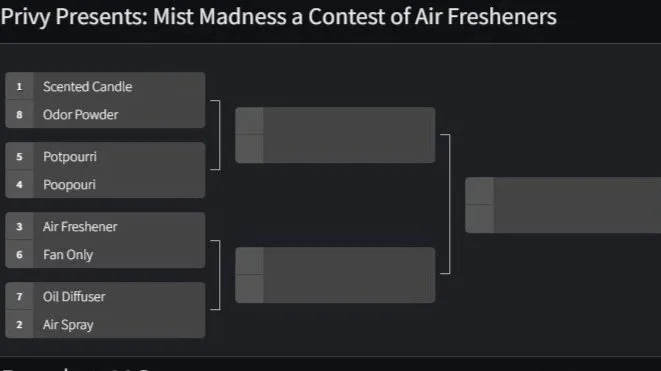
Welcome to Mist Madness, a tournament to determine the greatest bathroom air-freshening method of all time.
In this round, we’re looking at two heavy hitters:
Scented candles (one of the oldest odor-fighting tools in history)
Poo-Pourri (a modern spray that tries to stop stink before it escapes)
Let’s explore the strange and surprisingly long history behind both.
The Surprisingly Ancient History of Scented Candles
Candles have been around for thousands of years, but they didn’t start out smelling like “Clementine Mango Paradise” or “Fresh Laundry Escape.”
Originally, candles were made from animal fat, also known as tallow.
And if you’ve ever smelled burning grease, you already know the problem.
Early candles weren’t designed to smell good. They were simply meant to provide light. Ancient versions often looked more like torches: a chunk of fat with a stick or rag acting as a wick.
So yes, historically speaking, lighting your house probably made it smell like burnt meat grease.
Which, while atmospheric, wasn’t exactly relaxing.
Where Did the Candle Wick Come From?
The development of the candle wick is where things really evolved.
Early wicks were… creative.
Some historical accounts suggest people used:
Plant fibers
Braided animal hair
Even insect parts
If you’ve ever accidentally burned hair, you know this was not an improvement.
Eventually, civilizations improved the design by braiding cotton fibers into wicks that could burn more cleanly and efficiently.
This allowed candles to burn longer, brighter, and with less horrifying smells.
The Medieval Candle Industry (Yes, That Was a Job)
During the Middle Ages, candles became big business.
Professional candle makers were known as chandlers, and they produced candles using leftover fats from cooking and animal processing.
However, tallow candle production smelled so bad that many European cities actually banned candle makers from operating inside city limits.
Imagine your job being so stinky the government tells you to move outside town.
Eventually, wealthier households switched to beeswax candles, which smelled sweeter and burned cleaner, but were far more expensive.
Basically:
Poor people: animal-fat candles
Rich people: beeswax luxury lighting
The original scented candle upgrade package.
The Industrial Revolution Changed Candles Forever
In the 1800s, candle production became industrialized.
New materials changed everything, including paraffin wax, a by-product discovered during oil refining. Paraffin burned cleaner, brighter, and cheaper than previous materials.
Suddenly candles were easier to produce and more widely available.
But just as candle technology reached its peak…
Electricity showed up.
And candles were no longer necessary for lighting.
So what happened next?
Candles reinvented themselves.
Instead of light sources, they became decorative mood-setters, and eventually, tools for making rooms smell better.
Enter the modern scented candle.
Enter Poo-Pourri: The Pre-Poop Air Freshener
While candles try to mask odors after the fact, Poo-Pourri attempts something more ambitious.
It tries to stop the stink before it escapes the toilet.
Yes, really.
The product was created by entrepreneur Suzy Batiz, who reportedly got the idea after a dinner party guest absolutely destroyed a bathroom, and the smell disrupted everyone still trying to eat dinner.
Which, to be fair, is the worst possible party trick.
Batiz began experimenting with essential oil mixtures, testing them by asking her husband to try them during bathroom visits.
Marriage is about teamwork.
Eventually, they discovered something interesting.
How Poo-Pourri Actually Works
The concept behind Poo-Pourri is surprisingly simple.
Before using the toilet, you spray the mixture into the bowl.
The essential oils form a thin layer across the surface of the water.
When you… you know… do the thing… the odor molecules get trapped beneath that oil barrier, preventing the smell from rising into the room.
In theory, the stink stays in the toilet instead of floating into the air.
It’s basically a force field for bathroom odors.
The Marketing That Made Poo-Pourri Famous
Although the product worked, it didn’t initially explode in popularity.
That changed in 2013 when the company released its now-famous viral ad:
“Girls Don’t Poop.”
The commercial leaned into the awkward humor of bathroom habits and quickly went viral online, turning Poo-Pourri into a household name.
And while the marketing was cheeky, the product actually does what it claims.
Which, in the world of bathroom products, is already impressive.
The Mist Madness Showdown
So where do these contenders stand in the battle for bathroom freshness?
Scented Candles
Pros:
Long history
Pleasant atmosphere
Widely available
Cons:
Only masks odors
Requires open flame
Not always bathroom-friendly
Poo-Pourri
Pros:
Stops odor before it spreads
Portable
Surprisingly effective
Cons:
Must be used before the damage begins
Limited lifespan once sprayed
In other words:
Candles try to fix the problem afterward.
Poo-Pourri tries to prevent the problem entirely.
Which Bathroom Freshener Wins?
That’s where Mist Madness comes in.
Listeners and readers vote on the best bathroom air-freshening method based on:
Effectiveness
Ease of use
Accessibility
Popular opinion
By the end of the tournament, one champion of odor control will emerge.
Until then…
Fill out your bracket, trust your nose, and remember:
Everyone poops. But not everyone plans ahead.
And as always.
Don’t forget to flush.
